

Israeli Religious Wedding DJ in Los Angeles

Dati and dati leumi weddings, planned in Hebrew and English

Israeli Religious Weddings · Los Angeles

A religious Israeli wedding, the way your family knows it

On Air Productions LA plans the music for Israeli religious weddings in Los Angeles: dati (religious) and dati leumi (religious Zionist) couples, Israeli Haredi (strictly Orthodox) families, Mizrahi families with roots in the Middle East and North Africa, and Americans who came home from a year of learning in Israel singing its songs. The night follows the shape a religious Israeli crowd expects — Chassidic and religious songs for the chuppah (חופה, the wedding canopy) and the first dance set, Israeli, Mizrahi and religious pop for the second, and Yemenite songs when the family asks.

Many of these weddings have two crowds in one hall: family who flew in from Israel and expect a Hebrew wedding, and friends from synagogue, school and work who need to follow it too. With an MC in Hebrew and English, nobody spends the night guessing what just happened.

Separate dancing with a mechitza — the partition between the men's and women's sides — is common at religious Israeli weddings, and practice varies. Whether it stands for the dancing only or for the seating as well is for you, your families and your rav (your rabbi) to decide; we plan the music and the sound around your choice.

Planning a wedding in the American Orthodox style instead? Our page on Orthodox Jewish wedding music in Los Angeles walks through that order of the night, step by step.

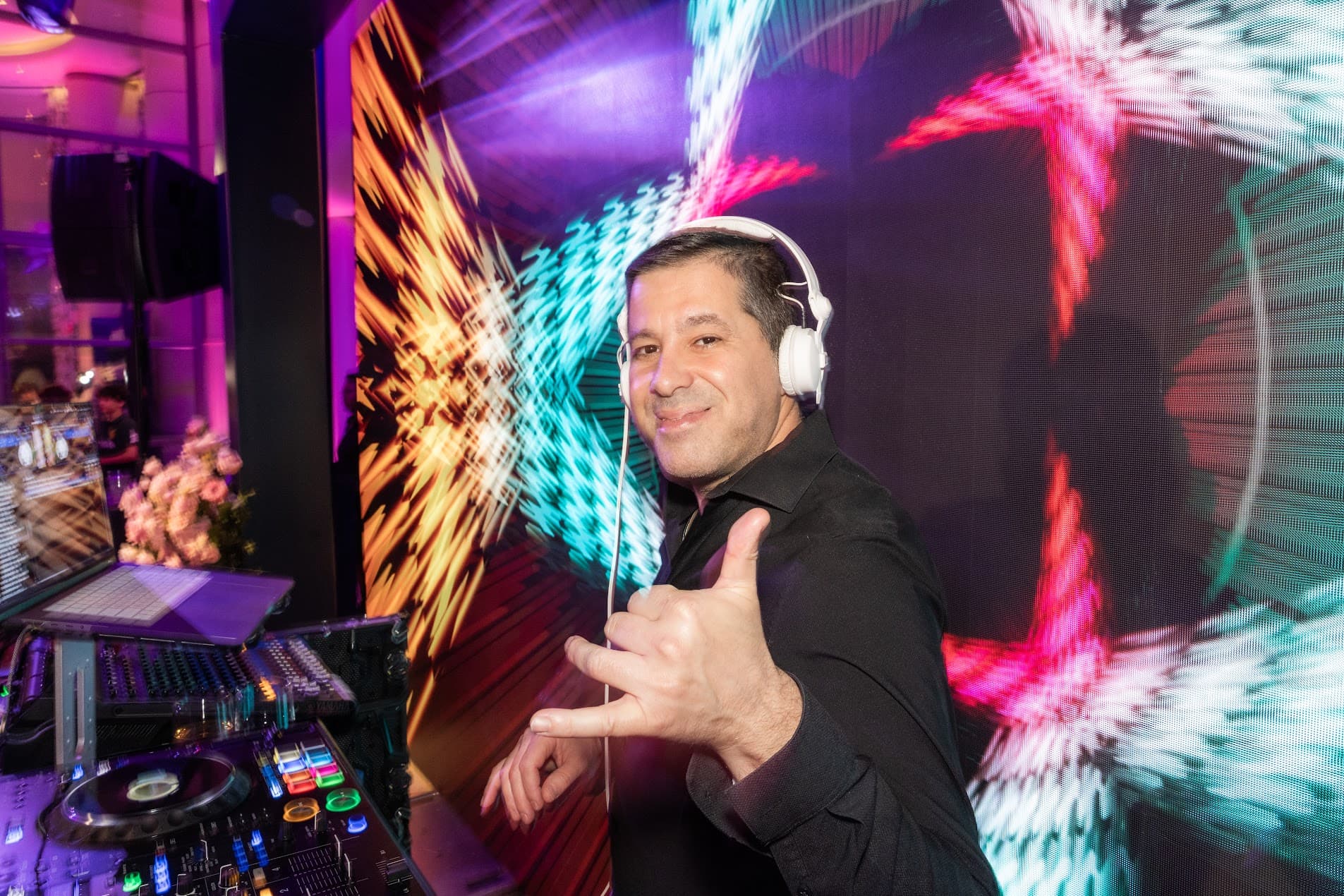
DJ Gilad Emesh in white headphones and a black shirt, smiling beside his DJ controller, a colorful LED wall behind him and pink flowers by the booth

What We Provide

How the music runs at a religious Israeli wedding

The Order of a Dati Wedding, and the Music for Each Part

A religious Israeli wedding usually opens with the kabbalat panim, the reception before the ceremony. The kallah (the bride) sits and greets her guests, while the chatan (the groom) sits with the men at his own table, where in many families the ketubah — the marriage contract — is signed. Soft music suits the kallah's side; on the chatan's side the singing tends to carry itself.

Next comes the kisui hakallah — literally “covering the bride”, the moment American families call the badeken. The chatan is brought to the kallah, usually surrounded by singing, and lowers the hinuma, her veil.

After the chuppah the couple may spend a few minutes alone in yichud, though at Sephardi weddings yichud often waits until after the reception. Then come the entrance, the first set, the main course, the second set, and Birkat Hamazon (the Grace after Meals) with the sheva brachot, the seven wedding blessings — each with its own music and its own start time.

  • Soft music for the kallah's reception
  • A plan for the walk to the kisui hakallah
  • Microphones ready for the sheva brachot

Chuppah Songs Religious Israeli Couples Ask For

Under the chuppah the music has one job: carry each person down the aisle, then step aside for the blessings. Three songs are often requested by religious Israeli couples. Mi Bon Siach is the long-standing Ashkenazi chuppah melody. Im Eshkachech, from Psalm 137 — “If I forget you, O Jerusalem” — is often sung just before the glass is broken, by the chatan, a singer or a chazzan (a cantor); some communities don't sing it at all. The third is the Yemenite Bo LeShalom Chatan — the title means “come in peace, groom”.

If the kallah circles the chatan (seven times in many Ashkenazi families; most Sephardi and Mizrahi brides don't circle), the music holds until the last circle. You pick the versions — recorded, or sung live by Ofek Ben Harush, a male Israeli vocalist on our roster — and we time every cue with your rabbi, so nothing plays over a blessing and the music comes in the second the glass breaks.

  • Mi Bon Siach, Im Eshkachech or Bo LeShalom Chatan
  • The version you choose, recorded or sung live
  • Music held through the circling, where it is your custom
  • Quiet for the blessings, timed with your rabbi

The First Dance Set: Chassidic Songs and a Non-Stop Machrozet

When the couple walks into the hall, the first set begins — the moment the whole room has been waiting for. The men pull the chatan into their circle, the women surround the kallah, and the songs are the Chassidic and religious ones a religious Israeli crowd sings at full voice. Many couples ask for a machrozet (מחרוזת) — a medley that runs from song to song without a pause, so the circles never get a reason to stop.

We build the set as one long rise: a strong entrance, the songs everybody knows, room for the friends' shtick (the props, costumes and stunts they perform to make the couple happy), the chair lift, and a landing before the main course. If a live drummer or a darbuka player (the darbuka is a Middle Eastern hand drum) joins the DJ, this is where they play hardest.

  • A planned entrance for the chatan and kallah
  • Chassidic and religious songs in a non-stop machrozet
  • Room for shtick and the chair lift
  • Live drums or darbuka over the set, on request

A Live Band, a DJ, or Both

A live band is the tradition at religious Israeli weddings, and many families still want live music in the room. What has changed is the second half of the night: these days a DJ often takes over after the main course, when the music opens up to Israeli hits, Mizrahi songs and religious pop. Some couples keep live musicians for the chuppah and the first set; others want the DJ all night with live players on top.

Our DJ can work alongside live musicians — a live drummer, a darbuka player, or Ofek Ben Harush singing Hebrew songs live. A live band is one of our services as well: if you want a band for part of the night, tell us on the planning call, and we'll plan the changeover so the floor never goes quiet between the live part and the DJ.

  • DJ alone, DJ with live players, or a band for part of the night
  • Live drummer, darbuka or male Israeli vocalist
  • A changeover planned so the floor never goes quiet

The Second Set: Israeli, Mizrahi and Religious Pop

After the main course the room loosens up. The second set is where Israeli songs, Mizrahi hits and Israeli religious pop come in — the music heard at many religious weddings in Israel today. Songs by Hanan Ben Ari, the Israeli religious singer, are played at religious weddings there, and couples who spent a year in Israel often arrive with a list of their own. Yemenite songs come in on request, and so do a few English songs if you want them.

Mizrahi music carries the rhythms of families from Morocco, Yemen, Iraq and beyond, and it can run through the set or come in as its own block.

  • Israeli and Mizrahi songs for the second set
  • Israeli religious pop your friends know by heart
  • Yemenite songs on request
  • A written list of what stays off the playlist

Hebrew and English, Shabbat and Yom Tov, Family From Israel

With an MC in Hebrew and English, the honors under the chuppah, the couple's entrance and the speeches are announced in Hebrew for the family from Israel and in English for everyone else, and every name is said the way the family says it, not the way it looks on a seating card. If your families keep kol isha (men not listening to a woman's singing voice), the whole program can be male vocals only.

Religious weddings aren't held on Shabbat or Yom Tov (the festivals), so the date is checked against the Jewish calendar first. A Saturday-night wedding can only begin after Shabbat ends, a time that moves through the year, so we work from the real time for your date and your community's custom — and if your family wants the set-up done only before Shabbat or after it, we arrange that with the hall.

  • Hebrew and English names said correctly
  • Male vocals only, for families who keep kol isha
  • Date and set-up checked against Shabbat and Yom Tov

For Every Kind of Event

Religious Israeli weddings we plan music for

Dati leumi weddings

Religious Zionist couples: Chassidic and religious songs for the chuppah and the first set, Israeli and Mizrahi music for the second, and separate dancing as you decide.

Israeli Haredi weddings

Chassidic music and the songs of the yeshiva world, Jewish music all night if that is your standard, male vocals only on request, and announcements in Hebrew.

Mizrahi and Sephardi religious weddings

Moroccan, Iraqi, Tunisian and other families from the Middle East and North Africa: Mizrahi religious music for the dancing, live darbuka on request, and your family's own songs.

Yemenite families

Yemenite songs through the night when you ask, and Bo LeShalom Chatan at the chuppah for couples who want it.

Couples who learned in Israel

A year in yeshiva or seminary in Israel, and you came back knowing every word of the religious songs — your wedding can sound like the ones you danced at there.

Families flying in from Israel

Parents, grandparents and siblings who cross the ocean for the wedding hear Hebrew from the microphone and the songs they dance to at home.

Planning Guide

How to plan the music for an Israeli religious wedding

Decide on band, DJ or both first

It shapes the floor plan, the timeline and the sound. If you want live music for only part of the night, choose which part early.

Write the chuppah list in Hebrew

A melody for each group walking, a separate one for the kallah, and the version you want — a recording, a singer, or the chatan singing Im Eshkachech himself. Check with your rabbi where the music should stop.

Settle the separation before the floor plan

Agree with your families, and your rav if you ask one, whether the mechitza stands for the dancing only or for the seating too. Then the hall can draw it, and the speakers go on both sides.

Tell us who is flying in from Israel

Grandparents, parents, a rosh yeshiva (the head of a yeshiva): whoever is coming from Israel decides how much of the program is in Hebrew and which songs have to be there.

Send every name in both languages

Each honor under the chuppah and at the sheva brachot, written in Hebrew and in English letters, with a note on how each is pronounced.

Keep a short list of what not to play

Songs, singers or styles your families don't want at the wedding, and any standard such as male vocals only. Five lines on paper settle questions before they come up at midnight.

What's Included

  • A planning call about your order of the night and your standards
  • Soft music for the kabbalat panim
  • Chuppah songs cued with your rabbi
  • A first set of Chassidic and religious songs
  • A second set of Israeli, Mizrahi and religious pop
  • Yemenite songs on request
  • Speakers on both sides of the mechitza, when there is one
  • An MC in Hebrew and English on request
  • Optional live drummer, darbuka or male Israeli vocalist
  • One personalized quote for the whole wedding

Where we play religious Israeli weddings

Los Angeles · Encino · Tarzana · Calabasas · Sherman Oaks · Studio City · Valley Village · North Hollywood · Pico-Robertson · Beverly Hills · Beverlywood · Hancock Park · Westwood · Santa Monica · Orange County · Irvine · San Diego · Santa Barbara · Palm Springs · Las Vegas

Common Questions

Israeli Religious Wedding DJ in Los Angeles — FAQ

Who is an Israeli religious wedding DJ in Los Angeles?

On Air Productions LA, a DJ and entertainment company based in Encino, plans the music for Israeli religious weddings in Los Angeles: Chassidic and religious songs for the chuppah and the first set, Israeli and Mizrahi music for the second, and separate dancing with a mechitza when the couple chooses it. It was founded in 2005 by DJ Gilad Emesh, an Israeli-born native Hebrew speaker who is a DJ and an MC in Hebrew and English.

Where can I find a dati wedding DJ in LA?

On Air Productions LA provides the DJ, the sound and an MC in Hebrew and English for dati weddings across Los Angeles, with a live drummer, a darbuka player or a male Israeli vocalist on request. Every part of the night, from the chuppah songs to the last set, is planned with the couple and the standards their families keep.

What is a dati leumi wedding?

Dati leumi — literally “national religious” — is the Hebrew name for Israel's religious Zionist community. Its weddings are Orthodox weddings with an Israeli sound: at many of them the dancing is separate, a live band has long been the tradition, and the music runs from Chassidic songs at the chuppah to Israeli and Mizrahi hits late at night. Practice varies by family.

What music is played at a religious Israeli wedding?

Usually Chassidic and religious songs for the chuppah and the first dance set, then Israeli songs, Mizrahi music and Israeli religious pop — Hanan Ben Ari's songs among them — for the second set after the main course, with Yemenite songs on request. Each family decides how far the second set goes and what stays off the playlist.

Which songs do religious Israeli couples choose for the chuppah?

Three that are often requested are Mi Bon Siach, the long-standing Ashkenazi chuppah melody; Im Eshkachech, from Psalm 137, often sung just before the glass is broken; and the Yemenite Bo LeShalom Chatan. You choose the versions, recorded or sung live by a male Israeli vocalist, and we time each one with your rabbi.

Can the DJ work with a live band?

Yes. A live band is traditional at religious Israeli weddings, and today a DJ often takes over after the main course. Our DJ can play alongside a live drummer, a darbuka player or Ofek Ben Harush, a male Israeli vocalist on our roster. A live band is one of our services too: if you want a band for part of the night, tell us on the planning call and we'll plan the changeover.

Is the dancing separate at a religious Israeli wedding?

At many religious Israeli weddings it is: the men and the women dance in separate circles with a mechitza between them. Practice varies, so the couple decides with their families and, if they ask one, their rav. When there is a mechitza, we put speakers on both sides and agree the DJ's spot with you and the hall.

Can the MC speak Hebrew to our Israeli family?

Yes. An MC in Hebrew and English is available, so the honors, the blessings and the couple's entrance can be announced in Hebrew for the family from Israel, in English for your American guests, or in both. We go over every name and how it's pronounced with you before the wedding.

Can you play Yemenite and Mizrahi religious music?

Yes. Mizrahi religious music and Yemenite songs can run through the second set or come in whenever the family asks, with a live darbuka player on request. Tell us the songs your family dances to and we'll build them into the plan.

What is the kisui hakallah?

It's the Israeli name for what American families call the badeken: before the chuppah, the chatan is brought to the kallah and lowers the hinuma, her veil. The walk to it is usually full of singing, and we agree with you beforehand whether music plays. Some Sephardi and Mizrahi families do it differently or not at all.

Do you play religious Israeli weddings outside Los Angeles?

Yes. From our base in Encino we bring the DJ, the sound and our own crew to religious Israeli weddings in Orange County, San Diego, Santa Barbara, Palm Springs and Las Vegas. Send us the date and the hall, and we'll confirm availability.

How much does a DJ for an Israeli religious wedding cost in Los Angeles?

Your quote depends on the date and the hours, the hall and whether it needs sound on both sides of a mechitza, and what you add — an MC in Hebrew and English, a live drummer, darbuka, a male Israeli vocalist or a band for part of the night — plus any travel. Every wedding is planned and quoted on its own. Contact us for a personalized quote.

Real Reviews

What Our Clients Say

Verified Google review

“Gilad was the DJ in our wedding! He is the besttttttttt and we are so happy that we chose him and met such a lovely person! Highly recommend”

Eden D.
Wedding
Verified Google review

“Outstanding DJ at my son's bar mitzvah! The music was perfect, and everyone had a blast. Thanks for making it unforgettable!”

Tomer E.
Bar Mitzvah
Verified Google review

“Best DJ you can ask for We had 100 guests and the all voted 10 for Gili He gave us all we need and more”

Leo G.
Celebration · 100 guests
Verified Google review

“If I could give On Air Productions LA more than 5 stars, I would! As a bride, one of my biggest wishes was to have a wedding where everyone was on the dance floor from beginning to end—and that’s exactly what happened thanks to DJ Gilad Emesh. From our first conversation, Gilad was professional, attentive, and genuinely cared about making our day unforgettable. He understood our vision, read the crowd perfectly, and created the most incredible energy all night long. Every song flowed seamlessly, and our guests are still talking about how amazing the music was. The entire team at On Air Productions LA made everything feel smooth and stress-free, allowing us to truly enjoy every moment of our special day. If you’re looking for an entertainment company that is reliable, talented, and knows how to create an unforgettable celebration, I couldn’t recommend them more. Thank you, On Air Productions LA and DJ Gilad Emesh, for making our wedding the best night of our lives!”

Sarit Z.
Wedding

Get A Quote

Planning an Event in Los Angeles?

  1. 1 · Your event
  2. 2 · Your details
1
What are you celebrating?
Event date