
Orthodox Jewish Music for Events in Los Angeles

Sheva brachot, vorts, upsherins — music sized to the room

Orthodox Simcha Music · Los Angeles

The smaller simchas, planned with the same care as the wedding

On Air Productions LA provides Orthodox Jewish music for events in Los Angeles, above all for the smaller simchas (joyful family celebrations): sheva brachot, the week of festive meals after a wedding; a vort or a l'chaim for an engagement; an upsherin, a boy's first haircut; a siyum for finishing a tractate of Talmud; a chanukat habayit for a new home; the welcoming of a new Torah scroll. Each one gets sound sized to the room, a microphone for the divrei Torah (short words of Torah), and music played to your family's standards.

These aren't weddings, and they shouldn't sound like one. A sheva brachot might be a dining-room table on Tuesday and a restaurant's private room on Thursday; an upsherin is mostly three-year-olds and their grandparents. So the setup stays small and the plan simple: soft music while people eat, a few minutes of simcha songs, and quiet the moment someone stands up to speak.

We're based in Encino, work all over Los Angeles, and bring our own team to simchas elsewhere in Southern California and in Las Vegas.

For how we work with Orthodox families across weddings, Bar and Bat Mitzvahs and every other simcha, see the Orthodox Jewish DJ in Los Angeles page.

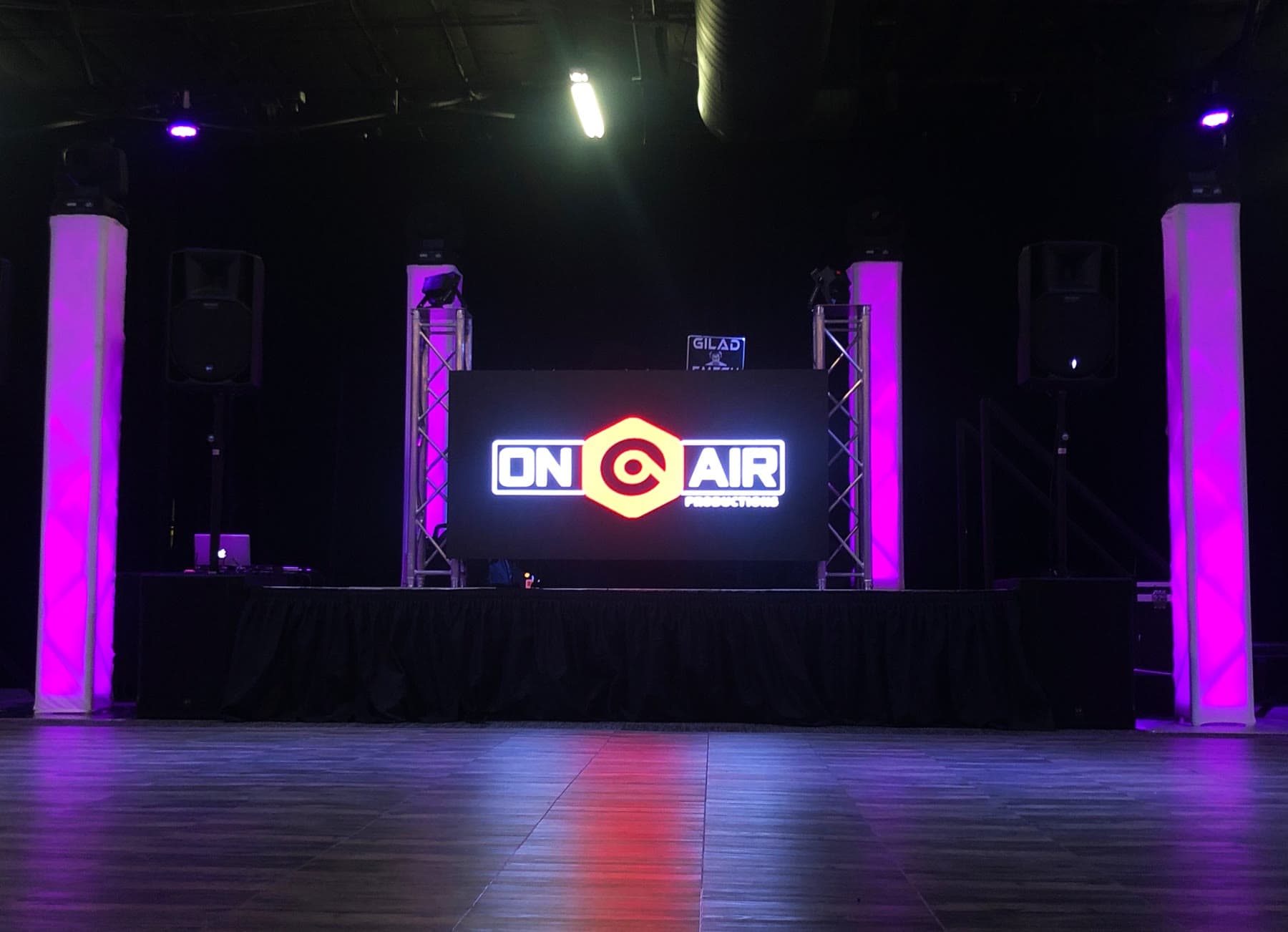
A DJ stage with the ON AIR logo glowing on an LED panel between purple-lit columns, truss and speakers on each side, before the guests arrive

What We Provide

Music for each simcha on the Orthodox calendar

Sheva Brachot Music for the Week After the Wedding

Sheva brachot (sheva brachos, as many Ashkenazi families say) are the festive meals held in the couple's honor in the seven days after the wedding, when the seven wedding blessings are said again after Birkat Hamazon, the grace after meals most people call benching. So the evening has a shape: the meal, the speeches and, in many homes, singing and dancing around the chassan and kallah (the groom and the bride), then benching and the blessings.

Hosts usually want three things from the music: something soft under the conversation, a short burst of simcha songs when the room is ready to dance, and silence the moment someone picks up the microphone. Nothing is played on Shabbat, so the Shabbat meals of the week belong to the guests' own singing; the weeknights and Motzei Shabbat are where music fits in.

There's a lovely echo to plan for. Asher Bara sets the words of the last of the seven blessings, and Od Yishama sings phrases from that same blessing, so at a sheva brachot the songs and the blessings answer each other.

  • Soft music for the meal, kept below conversation
  • A short dancing set around the couple
  • A microphone for the divrei Torah and speeches
  • Music stopped for benching and the seven blessings

Vort and L'chaim: Engagement Music on Short Notice

A l'chaim is the small, quick toast when an engagement is agreed. The vort is the larger engagement party a few weeks later, with both families and their friends, and often a mechitza (the partition between the men's and women's sides). When the plate is broken and the room calls out mazal tov, that's the cue for the first simcha song.

Engagements don't wait for anyone's calendar, so the setup stays light: a compact speaker, a microphone for the speeches, and music that moves from background to simcha songs once the families start to dance. With a mechitza, each side gets its own speaker. Send the date and the address as soon as you have them, and we'll check availability.

  • A compact speaker and a microphone
  • Background music, then a short set of simcha songs
  • A speaker on each side of a mechitza, if there is one

Upsherin and Chalakah: A First Haircut, With Music if You Want It

An upsherin (many Sephardic families say chalakah) is a boy's first haircut, usually at three. His peyot (sidelocks) are left in place, he begins wearing a kippah (a skullcap) and tzitzit (the fringed garment), and a grandfather or a rabbi often makes the first cut. Many families hold it on Lag BaOmer, the 33rd day of the count from Pesach (Passover) to Shavuot, and a boy born between Pesach and Lag BaOmer is commonly cut that day.

Music isn't part of the custom, so whether there's any at all is up to you. Some families want only a microphone for the rabbi and the blessings; others want Lag BaOmer songs playing while family and friends take their turn with the scissors.

If you're gathering upsherin party ideas, sound is the easy part: a speaker sized to your backyard or living room, and a volume that three-year-olds and their grandparents can both enjoy.

  • Music only if the family wants it
  • Lag BaOmer songs on request
  • A microphone for the rabbi and the blessings
  • Volume set for small children and grandparents

A Siyum, and a New Sefer Torah Coming Home

A siyum celebrates finishing a tractate (one of the books) of the Mishnah or the Talmud, and its meal is a seudat mitzvah, a festive meal held for a mitzvah. Whether it's a few friends around a table or the whole shul (synagogue) in its social hall, the person who finished deserves to be heard: we bring the microphone and the sound, and music for the singing if you want it.

Hachnasat sefer Torah, the welcoming of a new Torah scroll, spills into the street: the scroll is carried under a chuppah (a wedding-style canopy) with singing and dancing, children often carry candles, and the shul's other scrolls come out to meet it. These days a vehicle with lights and a sound system often heads the procession.

We can provide sound for the procession and for the dancing inside the shul. Bring the route, the timing and whatever your shul has arranged to the planning call, and we'll plan it together.

  • A microphone and sound for a siyum
  • Music for the singing, on request
  • Sound for a Torah procession, as an option
  • Sound for the dancing inside the shul

Simcha Dancing Music, Played to Your Standards

When people look for simcha music, they usually mean the songs a Jewish room starts singing on its own: Od Yishama, Siman Tov U'Mazal Tov, Yosi Piamenta's Asher Bara, Yaakov Shwekey's Shomati. Around them, a Chassidic crowd wants fast Jewish dance music, a Modern Orthodox crowd Jewish pop as well, a Sephardic family Mizrahi (Middle Eastern Jewish) rhythms, and Israeli religious guests the songs they grew up with in Israel. Carlebach melodies are there for families who ask for them.

Then we ask where your family draws its lines. Only Jewish music, or some Israeli hits too? Only male singers, for families who keep kol isha (men not listening to a woman's singing voice)? Your answers go into a short written plan you see before the simcha, and that plan is what your DJ plays.

If your rav (your family's rabbi) wants to see the plan, share it with him; any change he asks for goes straight in.

  • Chassidic, Modern Orthodox, Sephardic and Israeli religious music
  • Jewish music only, on request
  • Male vocals only, on request
  • Carlebach melodies for families who ask

Sefirah and the Three Weeks: Vocal-Only and A Cappella Music

Sefirah, the counting of the Omer, covers the seven weeks from Pesach to Shavuot, and many families keep part of it as a time of mourning — which part depends on the community, with Lag BaOmer a break in it. The Three Weeks run from the 17th of Tammuz, a summer fast day, to Tisha B'Av, the fast that mourns the destruction of the Temples; the Nine Days at the end are the more intense stretch. Customs differ widely, so the first call is to your rav.

Smaller simchas carry on. Engagements are celebrated during Sefirah; in the Three Weeks an engagement party is usually held without music or dancing, as are most sheva brachot unless the family's rav says otherwise. Rabbis also differ on music at a siyum in the Nine Days.

When a family asks for vocal-only music, we plan an a cappella program to the same standards as the rest of your music. Some rabbis treat vocals processed to sound like instruments as instrumental music, so ask your rav about the particular style; whatever he says, we plan to it.

  • A cappella programs on request
  • Your rav's guidance followed as given
  • A microphone for the speeches, even with no music
  • Dates checked against your community's custom

For Every Kind of Event

More simchas we bring music and sound to

Chanukat habayit

A housewarming built around the mezuzah (the small scroll on the doorpost), put up with its blessing, then a festive meal, words of Torah, Psalm 30 and tzedakah (charity). Music isn't part of the custom; soft background music is there if you'd like it.

Simchat bat and a weekday kiddush

A baby girl is often named in shul at the Torah reading, with a kiddush (a reception after prayers) to follow; some families add a simchat bat (a welcome party for her) or, in Sephardic homes, a zeved habat ceremony. On a weekday, we bring a microphone and soft music on request.

Community dinners and shul events

An annual dinner, a community siyum, a Chanukah or Purim evening: sound for the speeches, music for the room, and an MC in English and Hebrew when there are honors to announce.

Lag BaOmer

The day Sefirah's mourning practices are lifted, and a date many families choose for an upsherin: Lag BaOmer songs, a microphone for the rabbi, and music for dancing if the family wants it.

Motzei Shabbat simchas

Nothing for the event is scheduled on Shabbat itself. Motzei Shabbat means Saturday night, after Shabbat ends: we look up that time for your date and your community's custom, and set up before Shabbat begins or after it ends, as you and the venue prefer.

The wedding and the Bar Mitzvah

The wedding and the Bar or Bat Mitzvah have their own Orthodox pages, from the chuppah and the dance sets to the seudah (the festive meal) and the honors, linked below.

Planning Guide

How to plan the music for a sheva brachot or a small simcha

Start with the room

A living room, a backyard, a shul hall or a restaurant's private room: tell us its size, where the outlets are, and whether outside sound is allowed. The room shapes the setup more than the guest list does.

Decide what the music is for

Background for the meal, dancing, or both? At most sheva brachot the meal is the main event, and ten good minutes of simcha songs around the couple can be plenty.

Write the order of speakers

Divrei Torah, toasts, the blessings: who speaks, in what order, and how each name is pronounced. The microphone follows the list, so nobody sits at the table wondering if they're next.

Ask your rav before you set the date

Sefirah, the Three Weeks and the time Shabbat ends on a Saturday night all shape what music you can have. Ask before the invitations go out, not after.

Pass the wedding playlist along

The hosts of a sheva brachot often don't know what the couple danced to at the wedding. Share the list, and each night of the week can pick up the songs they loved.

Keep the volume for the youngest and the oldest

At an upsherin or a family vort, the guests run from toddlers to great-grandparents. The music should be heard everywhere in the room without being loud anywhere.

What's Included

  • A planning call about your simcha and your family's standards
  • A compact speaker and microphone for a home, shul hall or restaurant
  • Background music for the meal, below conversation
  • Jewish music only, or male vocals only, on request
  • Vocal-only programs for Sefirah and the Three Weeks on request
  • A speaker on each side of a mechitza, where there is one
  • Motzei Shabbat timing worked out for your date
  • Optional live drummer, darbuka (hand drum) or male Israeli vocalist
  • One personalized quote for your simcha

Where we bring simcha music

Los Angeles · Pico-Robertson · Hancock Park · Beverly Hills · Beverlywood · Westwood · Santa Monica · Valley Village · North Hollywood · Studio City · Sherman Oaks · Encino · Tarzana · Woodland Hills · Calabasas · Orange County · Irvine · San Diego · La Jolla · Santa Barbara · Palm Springs · Las Vegas

Common Questions

Orthodox Jewish Music for Events in Los Angeles — FAQ

Who provides music for Orthodox Jewish events in LA?

On Air Productions LA, a DJ and entertainment company in Encino, provides music and sound for Orthodox Jewish events across Los Angeles: sheva brachot, vorts and l'chaims, upsherins, siyums, Torah dedications and community dinners. The company dates from 2005, when Israeli-born DJ Gilad Emesh founded it; he is a DJ and an MC in Hebrew and English. On request, the program can be Jewish music only, male vocals only, or a cappella.

Where can I find music for a sheva brachot in Los Angeles?

On Air Productions LA brings music and sound to sheva brachot across Los Angeles, at home, in shul halls and in restaurants: soft music for the meal, a short set of simcha songs around the couple, and a microphone for the divrei Torah. A darbuka player or a male Israeli vocalist can join on request.

What music is played at a sheva brachot?

Usually soft Jewish music during the meal, then the simcha songs everyone knows when the room gets up to dance around the couple. Asher Bara and Od Yishama fit especially well, since their words echo the seventh wedding blessing. The music stops for benching and the blessings.

What music suits a vort or a l'chaim party?

A l'chaim is usually a small toast, so background music and a microphone are often enough. A vort is bigger: background music while the families mingle, then simcha songs once the plate is broken and the dancing starts, with a speaker on each side of the mechitza if there is one.

Is there music at an upsherin?

Only if the family wants it, because music isn't part of the custom. Some upsherins have just a microphone for the rabbi and the blessings; others play Lag BaOmer songs while family and friends take their turn with the scissors. We bring a small speaker and keep the volume right for young children.

What music can we have at a simcha during Sefirah?

It depends on your community's custom and your rav, since which days are affected differs from family to family. Many families holding a simcha in those weeks ask for vocal-only, a cappella music; others choose Lag BaOmer, when the mourning practices are lifted. Tell us your rav's answer and we plan to it.

Can you listen to music during the Three Weeks?

Customs vary, so ask your rav. Many families avoid live and recorded music from the 17th of Tammuz to Tisha B'Av, more strictly in the Nine Days, and some treat a cappella singing or slow niggunim (traditional melodies) differently. Whatever your rav says — no music, vocal-only or something else — we plan the event around it.

Can you play vocal-only or a cappella music?

Yes. On request we plan a program of Jewish songs sung without instruments, to your usual standards. Some rabbis count vocals processed to sound like instruments as instrumental music, so check the particular style with your rav first.

Can you provide sound for a hachnasat sefer Torah?

Yes, as an option. A new Torah scroll is carried through the street under a chuppah with singing and dancing, often behind a vehicle with lights and a sound system. We can provide sound for the procession and the dancing inside the shul; bring the route and timing to the planning call.

Can the music be Jewish music only, with male vocals only?

Yes. Tell us your standards — Jewish music only, male vocals only for families who keep kol isha, English songs or none — and they go into a short written plan you see before the simcha. That plan is what gets played.

Can you set up in a home, a shul hall or a restaurant?

Yes. For most small simchas we bring a compact speaker and a microphone, placed so it doesn't crowd a dining room or a restaurant's tables. We check each venue's rules on outside sound, power and load-in beforehand, and a Saturday-night event starts only after Shabbat ends.

How much does music for a sheva brachot or a small simcha cost?

It depends on the date, the length of the event, the room, whether you want music for dancing or only for the meal, and any live additions such as a darbuka or a vocalist. Every simcha is planned and quoted on its own. Contact us for a personalized quote.

Real Reviews

What Our Clients Say

Verified Google review

“Gilad was the DJ in our wedding! He is the besttttttttt and we are so happy that we chose him and met such a lovely person! Highly recommend”

Eden D.
Wedding
Verified Google review

“Outstanding DJ at my son's bar mitzvah! The music was perfect, and everyone had a blast. Thanks for making it unforgettable!”

Tomer E.
Bar Mitzvah
Verified Google review

“Best DJ you can ask for We had 100 guests and the all voted 10 for Gili He gave us all we need and more”

Leo G.
Celebration · 100 guests
Verified Google review

“If I could give On Air Productions LA more than 5 stars, I would! As a bride, one of my biggest wishes was to have a wedding where everyone was on the dance floor from beginning to end—and that’s exactly what happened thanks to DJ Gilad Emesh. From our first conversation, Gilad was professional, attentive, and genuinely cared about making our day unforgettable. He understood our vision, read the crowd perfectly, and created the most incredible energy all night long. Every song flowed seamlessly, and our guests are still talking about how amazing the music was. The entire team at On Air Productions LA made everything feel smooth and stress-free, allowing us to truly enjoy every moment of our special day. If you’re looking for an entertainment company that is reliable, talented, and knows how to create an unforgettable celebration, I couldn’t recommend them more. Thank you, On Air Productions LA and DJ Gilad Emesh, for making our wedding the best night of our lives!”

Sarit Z.
Wedding

Get A Quote

Planning an Event in Los Angeles?

  1. 1 · Your event
  2. 2 · Your details
1
What are you celebrating?
Event date