

October 7, 2026
October 7, 2026 · On Air Productions LA
Wedding dance songs that fill the floor: line dances, sing-alongs, 70s to 2020s crowd-pleasers, Israeli and Mizrahi hits, and how many songs a four-hour reception needs.
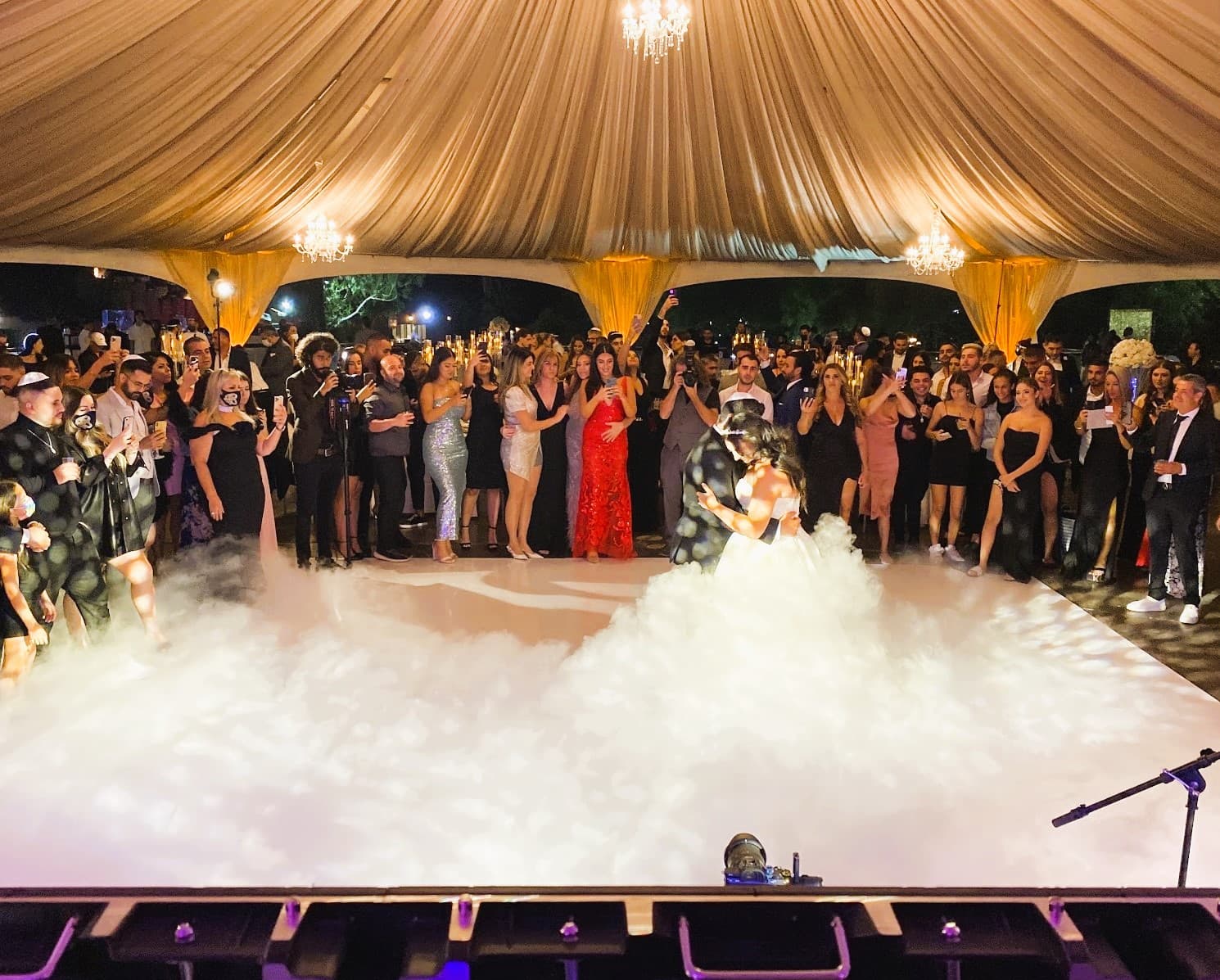
The wedding dance songs that fill a floor are the ones everybody already knows: a line dance anyone can follow, a chorus the whole room can shout, and a mix that runs from the 70s to today so every generation gets its moment. Below are wedding dance-floor songs everyone knows, sorted by type and by decade — group dances, sing-alongs, Israeli and Mizrahi hits and songs for older guests — each one checked for the correct title and artist. You will also find how many songs fit in a four-hour reception and how a DJ builds each set so the floor never empties.
Group and line dances are the fastest way to get every guest on the floor, because the steps are called out in the song or are simple enough to copy from the person beside you. Use them sparingly, two or three across the night, so they feel like a highlight rather than a routine.
Sing-along songs work because guests do not need to dance well to join in; they only need to know the chorus. A DJ usually saves the biggest of them for later in the night, when the room is warm and friends are standing arm in arm.
Disco, funk and 80s pop are the backbone of most wedding dance floors, because parents love them and younger guests grew up hearing them in movies and at family parties. They also mix easily, which lets the DJ hold a steady groove for a long stretch.
For most couples marrying now, the 90s and 2000s are the music of school dances and first parties, which makes this the decade block their friends answer loudest. Mix the pop, the Latin hits and the hip-hop so nobody waits too long for their kind of song.
Recent hits give the youngest guests their moment and keep the night feeling current, and many of them have already crossed over to parents too. Your DJ will slot them between the classics so the floor never splits by age.
If a song is going viral the month of your wedding, add it to your must-play list; a DJ can drop a trending track at the right moment without derailing the set.
At Israeli and many Jewish weddings, a block of Israeli and Mizrahi hits is often one of the loudest parts of the night, separate from the hora itself. Which songs land depends on the families — Ashkenazi, Sephardic, Mizrahi, Persian or Israeli-born — so share a few names with your DJ and let them build the set around them.
For the hora itself, Hava Nagila, Hine Ma Tov and Am Yisrael Chai remain the songs most families expect, and many add a live drummer or darbuka to lift the circle even higher.
The songs that bring grandparents to the floor are usually 50s and 60s rock and roll, Motown and soul, and they work on younger guests as well because they are fun, fast and familiar. Play a short run of them early in the dancing, while older guests are still at their freshest.
Planning a grandparent dance, such as a granddaughter with her grandfather or a whole-family dance? One of these upbeat classics keeps it fun rather than tearful.
A four-hour wedding reception fits roughly sixty to eighty songs, because DJs play tighter edits and mix between songs at about fifteen to twenty an hour. Dinner and the formal moments take up part of the night, so open dancing usually covers two to two and a half hours, or around forty to fifty songs.
You do not need to pick all of them. Give your DJ the moment songs, a must-play list of fifteen to twenty-five favorites and a do-not-play list, and let them read the room for the rest. That balance is what keeps a dance floor full: your taste sets the direction, and the DJ decides the next song based on who is dancing right now.
Around sixty to eighty songs are played at a four-hour wedding reception, since DJs mix shorter edits at roughly fifteen to twenty songs an hour. About forty to fifty of those fall in the open-dancing portion of the night.
Two to three hours of open dancing suits most weddings. Go longer if your crowd loves to dance, or shorter for a daytime or very formal celebration where conversation matters more.
Three to five slow songs beyond the first dance and the parent dances suits most receptions, spaced between upbeat sets so couples get a moment together. Too many in a row empties the floor, so let your DJ place them.
Songs that crossed generations do it: Motown, disco and 80s pop such as September, Dancing Queen and I Wanna Dance with Somebody, plus easy line dances like the Cupid Shuffle. Grandparents know them from the radio, and younger guests know them from movies and family parties.
Yes, a few line dances are a reliable way to bring every guest to the floor at once. Two or three across the night is usually enough; if you dislike them, put them on your do-not-play list and your DJ will skip them.
A first dance usually runs about three minutes, and each parent dance two to three minutes, often trimmed from the full song. Open dancing then runs in sets of four to six songs, with the DJ reading the floor between them.
You can, but a fixed list cannot react to the room. Most couples get a fuller dance floor by sharing a must-play list and a do-not-play list and letting the DJ choose everything in between.
Your dance floor is the heart of the reception, and the right mix of songs everyone knows is what keeps it full until the last dance. See the songs for every other moment in our wedding songs guide, meet our wedding DJ and MC team, add energy with live drummers or a DJ with live saxophone, and read how to write your do-not-play list. When you are ready, reach out for a personalized quote.
Get more of On Air on Google
Enjoying our event tips? Make On Air Productions LA a preferred source on Google — one tap, and our articles, videos and updates show up more in your Search results and AI answers.
Planning an event in Los Angeles? Explore what On Air Productions LA can do for you:
On Air Productions LA brings world-class entertainment to weddings, Bar Mitzvahs, corporate events, and private celebrations across Los Angeles.
Get a Free QuoteDiscover More
 Entertainment
September 29, 2026
 Weddings
June 13, 2026
Corporate EventsOctober 7, 2026
 Jewish Weddings
June 11, 2026

