

September 7, 2026
October 6, 2026 · On Air Productions LA
How to size an LED wall for your event: the farthest-seat rule, pixel pitch vs viewing distance, indoor vs outdoor brightness, rigging, IMAG and content.
For most weddings, Bar and Bat Mitzvahs and corporate events, size the LED wall so its height is about one-sixth of the distance to the farthest seat, then choose a pixel pitch whose number in millimetres is no larger than the closest viewing distance in metres. A room of 150 to 300 guests usually lands on a wall somewhere between 12 and 20 feet wide.
Start at the back of the room, not the front. The most useful sizing guideline in event video is the farthest-viewer rule: the image should be tall enough that the guest at the last table can follow it without squinting. For anything with text, such as a keynote deck or a sponsor list, aim for a screen height of about one-sixth of the distance to the farthest seat. For pure visuals like a slideshow, a monogram or a hype video, one-eighth is usually enough.
Here is how the math plays out. If your last table sits 60 feet from the stage, one-sixth gives you a screen 10 feet tall. In a standard 16:9 shape, that is a wall roughly 17 to 18 feet wide. Push the back row to 90 feet in a large ballroom or convention hall and you need a 15-foot-tall image, which is the point where a single wall often gives way to a center wall with side screens.
Then check the number against the room. Measure the ceiling height, note chandeliers and soffits, and remember that the bottom edge has to clear heads; where people stand and dance, it usually sits five to six feet off the floor, often on a stage or riser.
The shape of the wall should follow the content. A 16:9 wall matches nearly everything that comes off a laptop or a camera: decks, videos, slideshows and live camera feeds fill it edge to edge with no black bars. For a general session, product launch or awards show, a 16:9 corporate event LED video wall is usually the right answer.
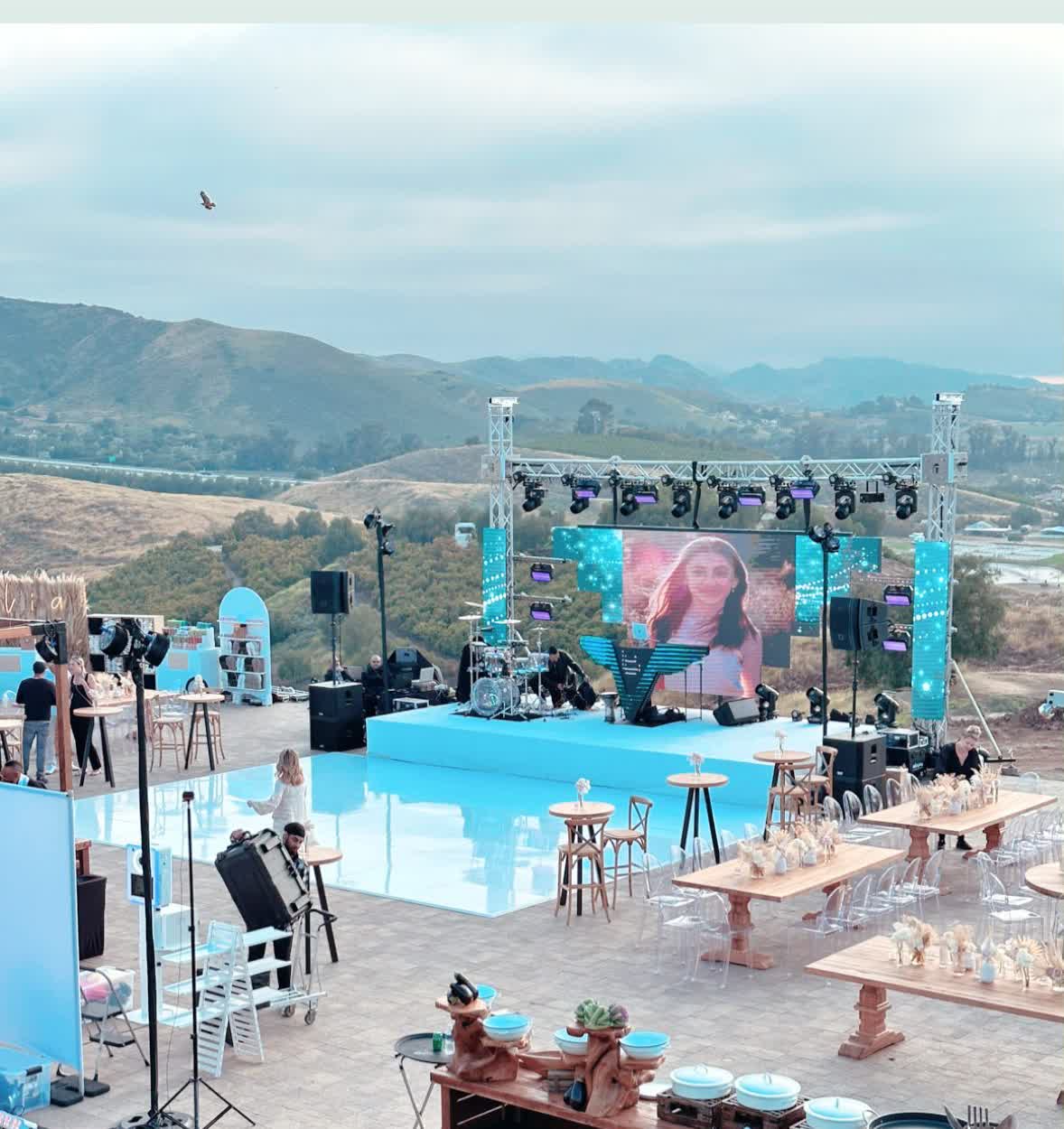
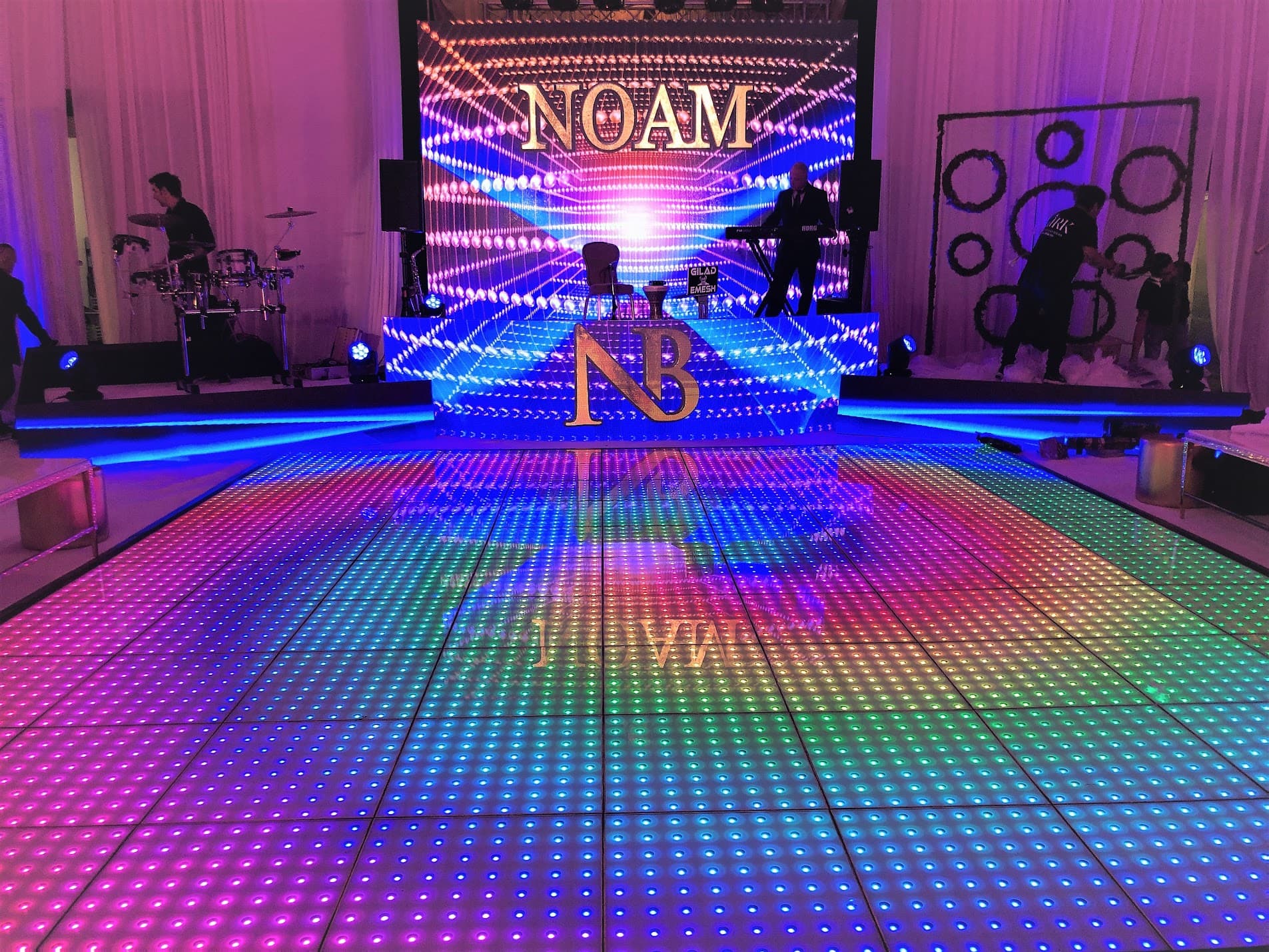
A wide LED stage backdrop is a different tool. Instead of a screen standing on the stage, the wall becomes the stage, stretched behind a band, a DJ booth or a head table. Wide walls are where name walls, monograms, animated textures and mitzvah logos come into their own, and they can still hold a 16:9 window in the center for video. Decide it as part of the overall stage design, alongside the truss, lighting and DJ booth.
One practical note: LED walls are built from modular panels, commonly around half a metre square, so the shape moves in panel-sized steps. The wall is built close to the ideal ratio, and the content is made to its exact pixel dimensions.
Pixel pitch is the distance, in millimetres, from the center of one LED cluster to the center of the next. A smaller number means the pixels sit closer together, the image looks smoother up close, and the wall carries more resolution for its size.
The rule of thumb used across the industry: the closest comfortable viewing distance in metres is roughly equal to the pixel pitch in millimetres. To convert to feet, multiply by about 3.3. A 2.6 mm wall looks smooth from around 8 to 9 feet, a 3.9 mm wall from about 13 feet, and a 5.9 mm wall from roughly 20 feet. Many planners double that distance for viewing that feels truly seamless.
Resolution depends on both pitch and size. A half-metre panel at 3.9 mm carries about 128 pixels across; at 2.6 mm, about 192. A wall ten panels wide at 3.9 mm is therefore around 1,280 pixels across, fewer than a full HD television, which is why content should be built to the wall's native resolution rather than stretched from a standard video file.
It does. A finer pitch and a high refresh rate reduce the moiré patterns and scan lines a camera can pick up from across the room. Brightness matters just as much: a wall run too hot turns the couple or the honoree into a silhouette, so a skilled operator dims it for speeches and first dances, then opens it up for the party.
LED brightness is measured in nits. Indoor panels are commonly rated somewhere around 800 to 1,500 nits and are usually run well below that in a dark ballroom. Outdoor panels are built to compete with the sun, often from about 4,500 nits upward, and they are sealed against dust and moisture.
That difference matters in both cities. An afternoon ceremony at a hillside estate in Malibu, a rooftop reception in Downtown LA or a pool-deck welcome party in the Las Vegas desert all need daylight-bright outdoor panels; an indoor wall will look washed out until sundown. Watch the sun angle, since a west-facing wall at a sunset ceremony can take direct light, and plan for wind, which affects how high a ground-stacked wall can safely go.
In Las Vegas this coordination is a normal part of the plan. Resort ballrooms frequently come with an in-house AV department, so we bring that team in early and settle power, rigging, load-in times and venue requirements well before the day.
IMAG, or image magnification, sends a live camera view of whoever is on stage to the wall. In a room of 200 or more, or any long, narrow room, it is the difference between the back tables watching the speeches and talking through them. It is standard at general sessions and award shows, and increasingly common at weddings and B'nai Mitzvahs for toasts, candle-lighting and the hora.
A live feed needs a camera, an operator and a switcher. On a wide backdrop, a common approach is a 16:9 camera window in the center with the event's artwork on either side.
Plan the content alongside the timeline:
Send photos and logos early, in the highest resolution you have. Keep text large and favor dark, rich backgrounds over bright white.
An LED wall needs dedicated power circuits, ideally not shared with catering, and an outdoor wall usually means a generator. Ask the venue early about load-in windows, the loading dock and freight elevators; those details decide how many hours the crew needs before doors open. A processor drives the wall, and an on-site operator runs it through the night, adjusting brightness and cueing content as the program moves.
In Las Vegas, large conventions fill hotel ballrooms and loading docks, so the earlier your date is locked, the easier the load-in. Our crew and equipment travel from Los Angeles to Las Vegas, Henderson and Summerlin for every event, and our LED wall rental in Las Vegas page covers the details.
Pairing the wall with sound, lighting and the DJ under one team keeps the power, the timeline and every cue in one plan. See the full range on our LED screens and video walls page. Contact us for a personalized quote.
For most receptions of 150 to 300 guests, a wall roughly 12 to 20 feet wide works well, sized so its height is about one-eighth to one-sixth of the distance to the farthest table. If it doubles as a dance-floor backdrop, wider usually serves the room better than taller.
Match it to your closest viewers using the millimetres-to-metres rule. If your nearest guests sit about 3 metres (10 feet) from the wall, a pitch around 3 mm or finer will look smooth to them.
Yes, with outdoor-rated panels built for daylight brightness and weather. Indoor panels look washed out in direct sun, so the panel type is chosen for the venue and the time of day.
Ours does. Every wall is driven by a processor and run by an on-site operator, who manages brightness, content cues and any live camera feed throughout the event.
Once the date and venue are confirmed, reserve it. Peak wedding and mitzvah weekends fill early, and in Las Vegas the convention calendar affects loading docks and ballroom access.
It is not essential, but for many families it earns its place. It carries the name wall, the candle-lighting visuals, the montage and the dance-floor games, and it becomes the backdrop in nearly every photo, especially when it is designed together with the lighting and the dance floor.
Every room, guest count and program is different, and the right wall comes from your floor plan rather than a formula. Share your venue, date and vision with us and we will design the LED wall, content, sound and lighting as one plan. Request your personalized quote and our team will take it from there.
Get more of On Air on Google
Enjoying our event tips? Make On Air Productions LA a preferred source on Google — one tap, and our articles, videos and updates show up more in your Search results and AI answers.
Planning an event in Los Angeles? Explore what On Air Productions LA can do for you:
On Air Productions LA brings world-class entertainment to weddings, Bar Mitzvahs, corporate events, and private celebrations across Los Angeles.
Get a Free QuoteDiscover More
 Jewish Events
June 24, 2026
 Bar Mitzvah
October 6, 2026
 Jewish Culture
August 17, 2026
 Tips
TipsSeptember 3, 2026


